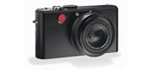
Compact digital cameras have become trend now in popularity, and consumer enthusiasm for the advantages offered by digital models shows no sign of changing. Many consumers are asking themselves what kind of digital camera they need? More and more are embracing digital compact cameras as their model of choice.
Contents
The size of a credit card, and not weighing much more, digital compact cameras come packed with options like video recording and touch-screen displays. They offer the versatility of a standard digital camera and the portability of a cell phone.
When compared against standard film cameras, the advantages of digital compact cameras are obvious. The savings in money and time are enormous! The cost of film and developing it are both removed, and there is no more waiting hours or days to get your photos back from the developer. There is also no more wondering whether you got the shot you wanted – you can always check your photographs and immediately know if you have that precious memory saved, or if you need another shot to capture it forever.
When compared against digital SLR cameras, there are also a number of distinct advantages to owning a compact digital camera:
Cost: Digital compact cameras are much less expensive than digital SLR cameras. You will be getting more bang for your buck with a compact model.
Point and Shoot: Digital compact cameras are designed to be easy to use in all conditions, and for a wide range of applications. There is no fussing with different settings for different types of pictures, and no need to be schooled in the principles of professional photography – you just point and shoot, and the camera takes care of the rest for you!
Easy to Share Pictures: Digital compact cameras offer less resolution than digital SLR cameras, but this is not the disadvantage that it might seem to be. This reduced resolution is usually not noticeable and still more than sufficient for 99% of your photography needs, but has the immediate benefit of smaller file size per picture. This makes it easy to quickly email, upload, and share your photographs. The bulky picture files created by SLRs can take a long time to upload, even with DSL or broadband service – digital compact camera photo files are designed to make sharing them a snap!
What to Look for in a Digital Compact Camera
Resolution – Most digital compact cameras on the market have sufficiently high resolution that you don't need to worry about too few pixels. If you plan on blowing up pictures to a larger size, or taking more detailed photos, go for 10mp or more. But remember more megapixels does not necessarily mean better photo quality. In digital compact cameras, manufacturers increase resolution for marketing and cost reasons, rarely for quality reasons.
Zoom – Most compact digital cameras come with a zoom feature – optically, digitally or both. Optical zoom measures the ability of the camera's lens and other parts to capture more light, and more detail, from a particular faraway point. Digital zoom crops the image and resizes it, giving the same effect as optical zoom but significantly reducing picture quality. If you shoot lots of close-ups, pick a camera with a high optical zoom and blow up the picture later with image editing software like Photoshop.
Battery Life – Battery life is measured by how many pictures you can take on a single charge – from 100 to more than 450. Digital compact cameras drain batteries at different rates, so think about your shooting habits. Are you outdoors or at home? Do you have access to an outlet or not? Buy accordingly. Battery life is usually good for all digital compact cameras, but get a model that features extended battery life if you anticipate a long time passing between charges.
Shutter Lag – It's the time between clicking the shutter button and the camera taking the picture, can range from 0.22 second to nearly two seconds. Pick the camera that suits your habits. You can hold still for a portrait, but you don't want to miss your child scoring a goal at school match.
Storage – High-megapixel cameras take great photos, but they also eat lots of memory. Most digital compact cameras ship with a relatively small memory card. Update to at least a 1GB (2GB or more is better) card to get the most out of your sessions.
Additional Features – Digital compact cameras with video capabilities are much in demand, and the difference in price is very modest. If you plan on taking your camera hiking, biking, or in harsh weather conditions, choose a sturdy, water-resistant model. Snapshots are usually taken on the fly without perfect composition or ideal lighting. A few features in particular can turn snap-photos into great photos.
- Red-eye reduction eliminates the annoying glare in eyes, which occurs when the flash reflects off the retinas. (Note: red-eye reduction slightly increases shutter lag.)
- To avoid camera shake, the blurred effect from subtle movements when shooting in low light or while zoomed, pick a compact digital camera with image stabilization (IS). IS digitally counteracts those subtle movements to shoot a clear picture.
- Facial recognition software centers on a subject's face, and adjusts aperture and shutter speed accordingly, making the face the focus of the shot. Or take it one step further with Sony's smile recognition feature – the camera focuses on the person's smile.
Popular Digital Compact Camera Brands
Nikon, Canon, and Olympus are names that need no introduction in the world of photography – their digital compact camera models are at the top of the field for both price and performance. FujiFilm has several very well-reviewed models at a number of different performance levels. Pentax and Panasonic have made an effort to focus on value, and they have a number of good entry-level models. Sony and Ricoh have several high-end models that offer outstanding performance and bridge the gap into the digital SLR range of cameras.

 Combine features
 Design
 Best 3D cameras
 Best optical IS cameras
 Best pocket cameras
 Best cheap cameras
 Best new cameras
 Buying Guide


 Drive sales with reviews on your site
Learn more about our B2B solutions
Drive sales with reviews on your site
Learn more about our B2B solutions
 alaTest USA
 alaTest UK
 alaTest Deutschland
 alaTest France
 alaTest Italia
 alaTest España